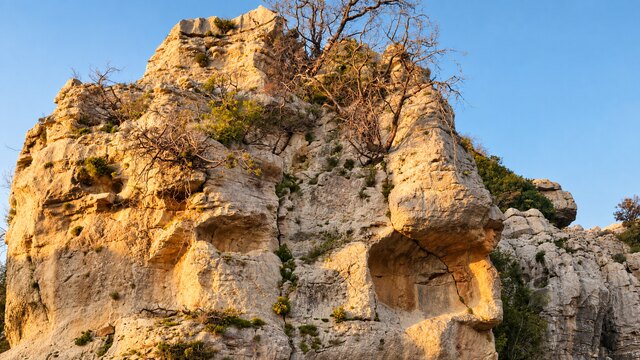
A weathered limestone outcrop above Douma at golden hour. Erosion has cut two human profiles into the rock, one on each side of the mass, with a bare tree growing from the summit.

1,450 m 34.2° N  35.8° E

The rock here has a face. Two of them.

A few stone houses cut into a limestone ridge above Douma, Lebanon.

You will hear the wind change direction.

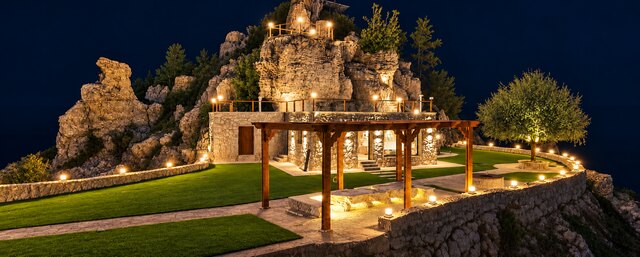
Cap de Douma is not a hotel. It is a small number of stone rooms built into a limestone ridge, an hour and three quarters from Beirut and about four hundred metres above the noise of it.

There is no lobby, no key card, no schedule pinned to the back of a door. There is a wood stove, a window the width of the room, and a valley that turns from green to gold to black over the course of an evening. Most people spend the first hour deciding what to do and the rest of the stay doing very little of it.

We keep the place small on purpose. Fewer rooms means the terrace is quiet at seven in the morning, and it means we know everyone who is here by name.

Close view of the limestone outcrop, showing the deep eye socket and jaw of the right-hand profile.

Nobody carved them.

Water did, and about a hundred and fifty million years of it. The ridge is Jurassic limestone, soft enough to dissolve and hard enough to hold a shape once it has one. Rain found the weak seams, froze in them each winter, widened them each spring, and left behind two profiles: one facing west into the sunset, one turned slightly inward, as though listening to the first.

Look for a few seconds and you see rock. Look for a minute and you cannot stop seeing the brow, the socket, the bridge of the nose, the line of a jaw. Guests argue about which one is older. There is no answer, which is most of the fun.

Read how the faces were found

An emperor owned this forest.

  1. AD 117 to 138

    The boundary letters

    Rome had cut through Lebanon’s cedar and fir for three centuries, and by Hadrian’s reign there was not enough timber left to build a fleet. So the emperor claimed what remained. Around two hundred boundary markers were cut into the limestone of northern Mount Lebanon, most of them carrying four abbreviated words: IMP HAD AVG DFS. Boundary of the forests of the Emperor Hadrian Augustus.

    They are catalogued as IGLS 5001 to 5187, and they exist nowhere else in the Roman world. Mount Lebanon has the only surviving imperial forest boundary in the empire.

  2. AD 317

    Castor is buried at Douma

    A sarcophagus found in the village carries a Greek inscription recording the burial of a man named Castor, who died in the year 317. It is the oldest name we have from this valley, and nothing else about him survives.

  3. From the 1800s

    Red roofs, and a French name

    The tiles on Douma’s old roofs were pressed outside Marseille. They came east in the second half of the nineteenth century, on the trade that carried Mount Lebanon’s silk the other way, and they are why a village in the Batroun hills is roofed like one in Provence. France then governed Lebanon under mandate from 1920 until independence in 1943, and left the language behind. It is still spoken here, on shop fronts and at kitchen tables.

    So the name on the gate is French, the way the roofs are. Cap is the word for a headland, the point where high ground runs out over the air. That is where these houses are cut in. Cap de Douma, the headland above Douma.

    Where the name comes from

  4. Today

    The signs on the trail

    Small markers are set along the paths across the property, each one pointing to something the mountain has kept: where the old terrace walls run, which trees were once counted as imperial, how far the boundary is thought to have reached. They are ours, not Rome’s. The letters that Rome cut are still out there on the mountain, and people are still finding them.

    Walk the marker trail

Three ways to sleep inside a rock.

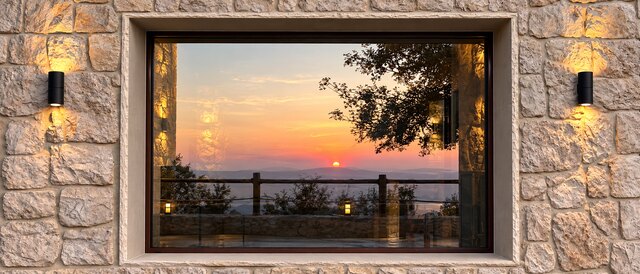
  • La Grande's picture window at dusk, stone facade either side and the valley ridge catching the last light through the glass.

    La Grande

    The largest of the houses, and the one people book again. Built against the rock face with a single pane running the width of the far wall, so the valley is the only thing on it, and the only one of the three with its own kitchen. The stove is lit before you arrive between November and April.

    Sleeps 2KitchenWood stoveValley window

  • La Grotta: a bed set into the raw rock niche, two lit lanterns on the ledge behind it and folded towels at the foot.

    La Grotta

    Carved back into the ridge itself, so three of its four walls are living rock. It stays cool through August without anything mechanical, and it is the quietest room on the property.

    Sleeps 2King bedRock wallsCool in summer

  • Gemelli: two matching beds facing each other under the vaulted stone ceiling, the ensuite door open beyond them.

    Gemelli

    Named for its two matching single beds rather than one shared one, at the lower end of the property where the old grove starts. The room for two people travelling together who are not necessarily sharing a bed.

    Sleeps 2Twin bedsGrove access

What there is to do, and what there is not.

Nothing here is scheduled. These are simply the things people end up doing.

  • Walking the ridge

    Marked paths run from the terrace along the top of the limestone and down into the valley. The long one takes about three hours and ends where the old terrace walls are still standing.

    Best March to June, and October

  • The bonfire

    Lit most evenings from the first cold week of autumn onward, in the stone pit at the top of the lawn. Bring something to put on it or do not; there is usually more wood than people.

    October to April

  • Stargazing

    Douma is far enough from the coast road that the Milky Way is visible on a clear moonless night. We turn the terrace lights off at eleven if anyone asks, and often when nobody does.

    Clearest June to September

  • The olive grove

    Some of the trees below the property are old enough that nobody in the village remembers them being planted. In November you can help with the harvest, which is less romantic and more fun than it sounds.

    Harvest in November

  • Photographing the faces

    The light that shows them best arrives about forty minutes before sunset and lasts around twenty. Ask at reception and someone will tell you exactly where to stand.

    Year round

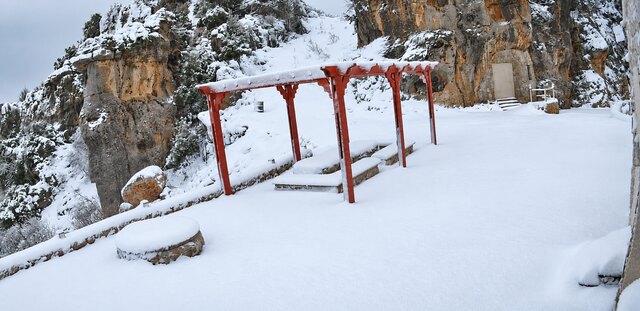
  • Snow on the terrace

    At 1,450 metres it settles a few times each winter, usually in January. The valley goes completely silent, and the stove earns its keep.

    December to February

The village below.

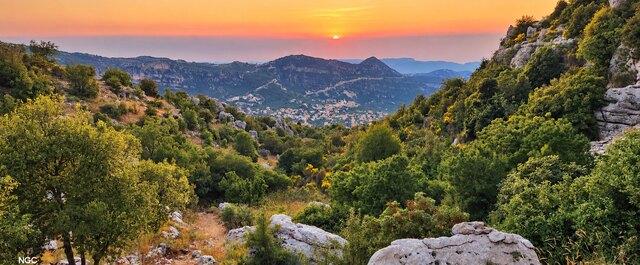
Douma sits in a bowl of mountains at the head of the valley, and almost every roof in it is the same red tile. It has been a market town for four centuries, and it is called Douma al-Hadid, Iron Douma, for the metal in its soil and the blacksmiths who worked it.

The old souk runs for a few hundred metres of vaulted stone. There is a Saturday market, three good bakeries, and a cemetery with a view better than most hotels. Byblos is thirty kilometres away, Tripoli forty five, and the cedar reserve at Tannourine is an easy morning.

Beirut 88 kmByblos 30 kmTripoli 45 km

Sunset over the Douma valley seen from the trail above Cap de Douma, with the red-tiled village in the middle distance and limestone outcrops in the foreground.
Wooden benches around an oak tree growing from a stone ring on the lawn at Cap de Douma, with a timber fence and the valley beyond at sunset.

The oak, and the three benches under it.

A single oak grows out of a round stone bed at the top of the lawn, with three benches set around it, angled outward toward the fence and the valley beyond rather than at each other.

There is no booking slot and no marked hour for it. People simply end up here for the last light, on the evenings the sky is doing something worth watching.

Lately, from the ridge

Follow on Instagram
Cap de Douma at night: the stone buildings and pergola lit from below, set against the dark limestone ridge.

Come up for a couple of nights.

Message us with your dates. Someone answers, usually within the hour.

Ask about dates